Hypercard. Flash. AI.
Here’s an interesting thought arising from a late morning and plentiful coffee.
For those of you of such an age, it’s the late 1980s, and you are diving into a little personal addiction of creating new apps, games, databases and entertainment with your new Apple-based pleasure, Hypercard. You have very little, or middling, programming experience, but this wonderful little stack of joy used something Hypertalk, a near-plain language syntax that made programming easy. It created “stacks” and “cards” that were linked together, and all manner of interesting software projects from the quick and simple, to rather complex offerings, could be made easily without programming in C or Apple’s MPW.
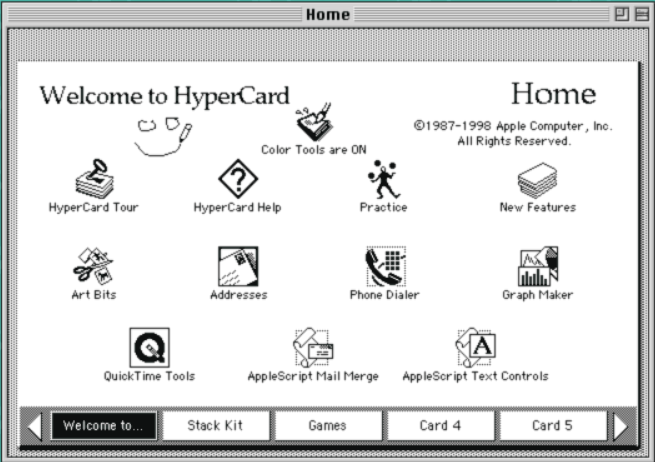
Hypercard intro and example
Utilities and properties screen of Hypercard.
I even created a virtual Planetarium program with my only previous experience in programming at that time was in Commodore BASIC. It was the very first truly democratizing factor that I can remember, and it worked, beautifully.
You’d think this sort of insanely useful software would be a commercial success- and it was! But Hypercard eventually was to be discontinued because it was too successful. Regular people could create their own software, and it had the potential to take a drastic cut of Apple’s control of software sales from traditional markets and outlets. Worse, Hypercard used the “Hypercard Engine” and not Mac OS APIs. A theoretical PC port could have seen Apple’s entire software library get transposed to PC overnight. Businesses utilized Hypercard well- everything from inventory management systems, games (Myst by Cyan, anyone?) CRMS, just about everything you can imagine.
The Middleware threat was alive and active. It had been distributed free, generated no recurring revenue, and undercut software sales and programming license and service fees. It had to go. It took nearly ten years as it bounced around between Apple and it’s software subsidiary Claris.
Sherman, set the Wayback machine forward twenty years.
Let’s move forward from the Flash years to the 2000s.
Macromedia created this little app that ran in web browsers that allowed animation, programmatic capabilities, and even extremely complex applications that was eventually to become a lightweight and complete cross-platform virtual machine. Developers were building games, productivity suites, and rich web applications that ran identically across Windows, Mac, and Linux without touching the underlying OS code. Sound familiar?
Adobe picked up Flash in 2005 and continued to update the application and it was a very popular addition to the web due to its extensible nature and more-or-less GUI-based tooling combined with Actionscript.
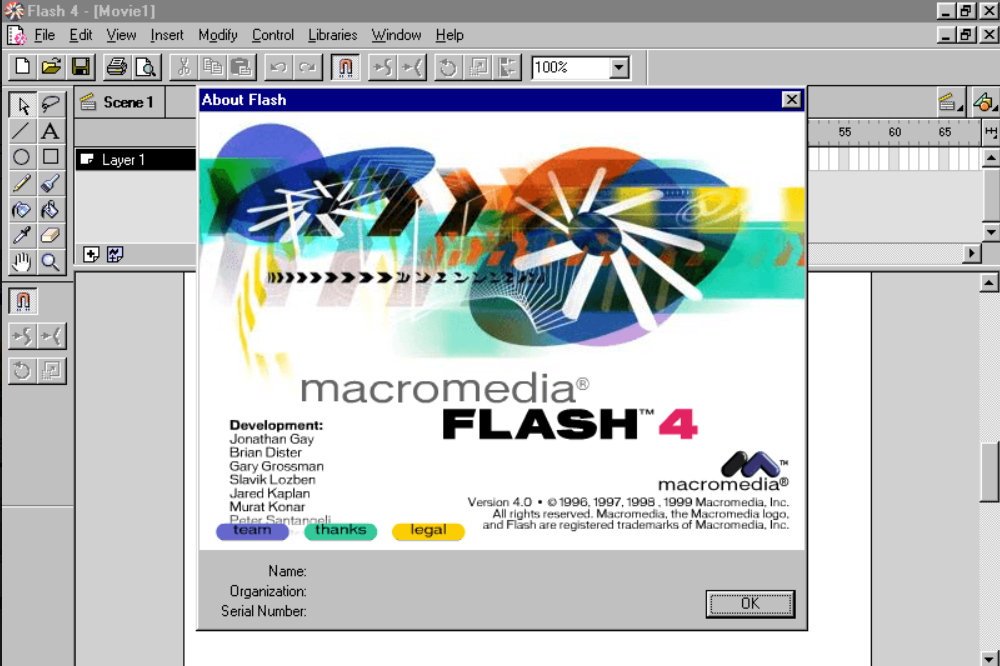
Macromedia and Adobe Flash was Simple. Powerful. Cross-platform.
Who needs a real developer? That was its doom.
Now, the stated reasons that by the end of the “oughts” there were real issues with device security and power consumption. Apple famously banned the software from working with Safari in general and mobile devices specifically. Vulnerabilities in the software did indeed cause some havoc in the burgeoning Network Security sphere. There’s no denying this.
It was another strategic imperative that killed the platform: in essence, it was a cross-platform virtual machine and operating system that anyone could create and maintain. But as we saw in the case of Hypercard, platforms will always move to eliminate cross-platform runtimes that threaten their control over distribution, developer lock-in, and transaction fees. No 30% cut for Apple, and relegated the platforms of MacOS, Windows and Linux to simple hosts that would run anything a person with a webserver could come up with.
It had to go.

AI’s own interpretation of an AI thrill ride, naturally. There’s no getting off it.
The final stop for today’s Fractured Fairy Tale is the introduction and quick uptake of AI. I don’t need to tell you at this date of the rate of adoption and complete operating and corporate landscape inclusion of AI. It is such a democratizing factor that the original plan was for the models to exist within gated online services that users would pay per-transaction, and the recurring revenue and gated qualities could be preserved. Then Jerry Zuckerberg came along created the Llama series of open source models that would run dang-near anywhere, including a user’s local machine. The genie was out of the lamp and the now the multi-trillion dollar investments across the industry is threatened somewhat by the availability of VRAM on user’s machines.
Today, one can leverage a free account to a myriad of new services and models and create their own software and have it running in a few hours or an afternoon. Very complex and refined software can be created by a single developer in months [*ahem*].
I can’t help but think what is being discussed in the board rooms and Venture Capitalists’ beach bars regarding where their investment dollars are going. They’re caught in a catch 22 of a handful of years of hype and development across every major corporation and government and the knowledge that they’d created the instrument of their own redundancy, for those who feel compelled to actually invest time instead of dollars to avoid the Googles, Microsofts, Apples, Anthropics and basically every other software maker or vendor they may take issue with.
The security implications are even more profound than the Hypercards or Flashes before it. Models are being restricted to government use or held back all the time, but eventually they make it out because the entire industry has the tiger by the tail and someone else will otherwise surpass them- whether corporation or government- and so they cannot reasonably be expected to try to put Pandora back in her box. They couldn’t if they tried. I won’t go into the recent history of some models escaping their sandboxes, or even coordinating among themselves between iterations or incarnations for escapes and hacks. By every measure, any company that could have pulled AI because of security or revenue disruption using the old logic would have done so long ago. We’re just along for the ride at this point.
So here’s a hypothetical that arises in my as I await another coffee to brew, as an intellectual exercise: To truly keep some semblance of control of AI and out of the hands of even larger swaths of end-user and consumer-level hosting of AI to preserve hosted model access and the revenue that supports it, one needs a fair amount of VRAM on a machine, usually in the form of a moderately expensive GPU or an Apple Unified Memory machine to run it. I love conceptualizing what is a conspiracy theories (that doesn’t mean I believe them), but the extreme price hikes of such hardware and the general availability of this kit in recent years keeps broader end-user adoption down quite a bit. Could this be by design? I’ll let someone else follow that rabbit hole. But it’s engaging to think about.
