AI, Copyright, and the Future of the Software Industry: There Won’t Be One
I know—it sounds like hyperbole coming from someone running a software company. But hear me out.
Looking at the collision between local AI models and software development in 2026, one uncomfortable truth is becoming obvious: investing millions of dollars in conventional, proprietary application code is rapidly turning into a losing proposition.
The industry’s instinct has been to lean on legal protection. Lawsuits and trade group lobbying will spend years wending their way through federal courts, debating training rights and derivative works. But focusing on copyright misses the real architectural shift.
Under copyright law (specifically 17 U.S.C. § 102(b) and precedent stretching from Lotus v. Borland to Google v. Oracle- Yes, I had to Google it), copyright protects the literal creative expression of code—it has never protected functional behavior, system logic, or methods of operation. AI doesn't copy the code. It accomplishes the ultimate, automated clean-room implementation: observing inputs, outputs, UI workflows, and data structures, then spitting out 100% original, non-infringing code that achieves the exact same functional outcome.
Once an autonomous local model can cleanly replicate application logic on demand, the proprietary code moat evaporates.
The Lego Set Reality of Modern Code
I’ve always compared software architecture to Legos. A finished application is rarely a monolithic block of hand-carved stone; it’s an assembly of standard bricks of varying sizes. Some are basic commands; others are standard classes and functions; many are massive open-source libraries, runtime utilities, and framework wrappers.
Just like looking at the classic Lego Galaxy Explorer set #497, one can merely look at a finished product and immediately tell how it was assembled. You just need the right bricks. Open-source ecosystems supply 80% of those bricks out of the box, and local AI now adds the glue on the fly.
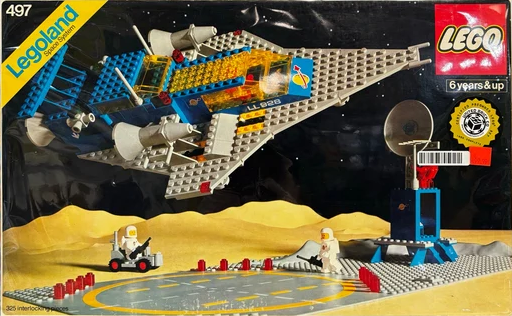
Lego Galaxy Explorer #497. Yes, I am that old.
To be clear: I am not suggesting that a local LLM is going to reimplement Autodesk’s more refined engineering stacks or rewrite Unreal Engine 5’s Nanite and Lumen pipelines from scratch over an afternoon. Thirty years of tweaking represent deep deterministic engineering that statistical models cannot reliably duplicate.
Rather, the disruption is aimed square at the vast middle tier of commercial software: the specialized tools, workflow wrappers, UI scaffolding, bespoke plugins, standard CRUD interfaces, internal business apps, and utility software. That multi-billion-dollar layer is about to disappear as an off-the-shelf market.
The Ephemeral Runtime: Software Built to Be Discarded
With the rise of high-speed local inference, unified memory architectures in consumer machines, and dedicated neural hardware, the distribution model changes. You won't buy static software licenses; your operating environment will assemble software on the fly on an ad-hoc basis, matched precisely to the task at hand.
I’d hate to be branded a low-budget, Temu-grade Syd Mead, but the Star Trek dynamic has arrived:
"Computer, analyze the thermal stress on these three alien ships and scrub through them along a temporal axis."
In the show, Picard never orders the crew to deploy an ELK stack, write schema parsers, or wire an ingestion pipeline. The intent is the application.

“Computer,…”
We are entering the era of ephemeral software:
You provide the intent and the raw data.
The local system spins up a temporary execution sandbox, writes the glue code, generates the visual interface, and runs the process.
When the task is complete, the UI and logic are garbage-collected out of memory.
Only the modified data survives.
The Solo Founder’s Dilemma: Escaping the Grist Mill
This isn't an abstract intellectual exercise for me—it’s an immediate survival calculation. As a solo developer who just launched a software company, watching functional code turn frictionless is both intoxicating and terrifying. It’s intoxicating because the leverage a single engineer possesses today is unprecedented; it’s terrifying because I have to look squarely at my product roadmap and ask an honest question: Am I pouring eighteen months of sweat equity into building tools that will simply become free fodder for the functionality grist mill of the coming decade? If the answer is yes, writing traditional "hard utilities"—the workflow accelerators, file parsers, etc.—is no longer a viable business strategy. It’s donating unpaid labor to an automated clean-room synthesizer.
For an independent builder trying to map out a sustainable existence, the mandate is clear: survive by steering away from utilitarian logic and anchoring into authored, proprietary depth. An AI model can observe an API interaction or a calculation routine and clone its functional mechanics in seconds, but it cannot manufacture a distinct aesthetic vision, a curated narrative world, or the subjective soul of human creative output. Moving forward, my longevity as a founder won’t come from being the fastest bricklayer in the repository; it will come from treating code as merely the canvas for original creative content, human storytelling, and curated experiences that a machine has no mandate to dream up on its own. Code is rapidly becoming the commodity; human intent is the only bastion left standing.
Where Value Migrates: State, Kernels, and Public MCPs
If functional application code is essentially free, what survives commercially?
Three things:
Regulated Certification and Liability: Mission-critical runtimes for healthcare, avionics, legal chains of custody, and fintech. Companies in these spaces don’t buy software for the logic; they buy audited validation, regulatory compliance, and someone to sue if the system fails.
Authored Culture and Creative IP: Mechanics can be replicated; human artistic intent, narrative worlds, and aesthetic point-of-view cannot.
Shared State and Protocol Gateways: You can clone the client logic and server architecture of a platform in minutes, but you cannot clone its network density or real-time synchronized state.
This last point is where the entire web infrastructure begins to rewire itself.
When user-side software becomes dynamic, why should a business spend millions maintaining separate web apps, mobile backends, customer portals, and fragmented REST APIs?
Instead, value will shift toward personal and business Model Context Protocol (MCP) gateways. An entity exposes its verified data model and operational tools behind an intelligent gateway layer. That gateway then dynamically reshapes the interaction based entirely on who—or what—is asking:
A legacy browser visits? The gateway serves standard HTML/CSS.
An autonomous procurement agent requests an invoice? It returns strict JSON-RPC via MCP.
A user's local workstation asks for an index? It streams structured semantic markdown directly into their vector store.
The long-abandoned dream of the Semantic Web won't be realized by human developers painstakingly tagging RDF schemas; it will be driven by dynamic edge translation layers breaking open legacy protocols and serving raw intent.
The Inevitable Horizon
We are merely waiting on three converging vectors: the continued drop in local inference latency, the economic models content providers settle on to charge for gateway ingestion (because ad-supported web models disintegrate when humans stop loading static web pages), and the inevitable regulatory battles attempting to slow this down.
For those of us building software today, the lesson is clear: if your product’s primary value proposition is the code itself, you are building on borrowed time. The future belongs to those who own the underlying state, the human creative intent, and the verified protocols through which the rest of the world connects.
